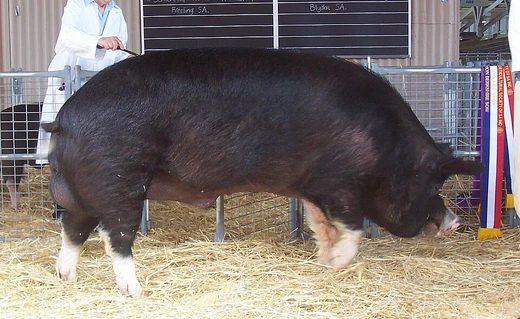
Berkshire pig
British pig breed known for its black coat and white markings.

Wikipedia / Wikimedia Commons
The Berkshire is a British breed of pig, originating in the English county of Berkshire. It is a rare breed in the United Kingdom but has been exported to many countries, including Australia, Japan, New Zealand, and the United States, where it is numerous in some of them.
- origin
- English county of Berkshire
- color
- Black with white on snout, lower legs, and tip of tail
- size
- Medium; adult boars about 280 kg, sows about 220 kg
- ears
- Prick-eared
- use
- Reared for pork
- conservation status
- Listed as vulnerable in 2008; fewer than 300 breeding sows known at that time
Lore & Background
The Berkshire is a traditional breed of the county of the same name. Until the eighteenth century it was a large tawny-coloured pig with lop ears, often with darker patches. In the late eighteenth and early nineteenth centuries it was substantially modified by cross-breeding with small black pigs imported from Asia. Herds are maintained in England by the Rare Breeds Survival Trust at Aldenham Country Park in Hertfordshire and at the South of England Rare Breeds Centre in Kent.
Reader's Guide
The Berkshire pig has historical significance as a traditional British breed that underwent substantial modification through cross-breeding with Asian pigs in the late eighteenth and early nineteenth centuries. It became the first pig breed to have a breed society, the American Berkshire Association, established in 1875, with the first registered pig being a boar named Ace of Spades, reportedly bred by Queen Victoria. The breed was listed as vulnerable in 2008, with fewer than 300 breeding sows known, but numbers increased due to revived popularity through its connection to Japanese marketing of a 'wagyu for pork' concept. Exports to Japan in the 1860s led to the development of the Kagoshima Berkshire, considered a separate breed, whose meat may be marketed as Kurobuta pork at a premium price. The Berkshire is reported to the DAD-IS database by twenty-three countries across the Americas, Asia, continental Europe, and Oceania. Although its meat has a relatively low pH, and high pH is normally correlated with consumer satisfaction, Berkshire pork was highly rated in taste tests in the United States.
Did You Know?
- The Berkshire is named after the English county of Berkshire.
- The first pig registered by the American Berkshire Association was a boar named Ace of Spades, reportedly bred by Queen Victoria.
- The Japanese Kagoshima Berkshire is considered a separate breed and its meat may be marketed as Kurobuta pork.
- In 2007 there were over 330,000 Berkshire pigs in Japan.
Frequently Asked Questions
What is a Berkshire pig?
It's a medium-sized British pig breed originally from the English county of Berkshire, raised primarily for pork. While rare in the UK itself, it has been exported to countries like Australia, Japan, New Zealand, and the United States, where it is more numerous.
What does a Berkshire pig look like?
These pigs sport a solid black coat with white markings on the snout, lower legs, and tail tip. They also have upright prick ears, giving them a distinctive silhouette compared to many other pig breeds.
How big do Berkshire pigs get?
Adult boars typically reach around 280 kg, while sows weigh roughly 220 kg. They are classified as a medium-sized breed overall.
Where did the Berkshire pig originate?
The breed traces its roots to the English county of Berkshire in the United Kingdom. It was later exported to numerous countries, including Australia, Japan, New Zealand, and the US, where it became more widespread.
Is the Berkshire pig an endangered or vulnerable breed?
Yes, it was listed as vulnerable in 2008, with fewer than 300 breeding sows recorded at that time. It remains a rare breed within the UK despite being more common in its export countries.
More in part-1
Spotted an error? Know more?
This is a living reference — every entry is fact-audited, and reader corrections feed straight into our audit queue. Suggest an edit · See this site's audit record