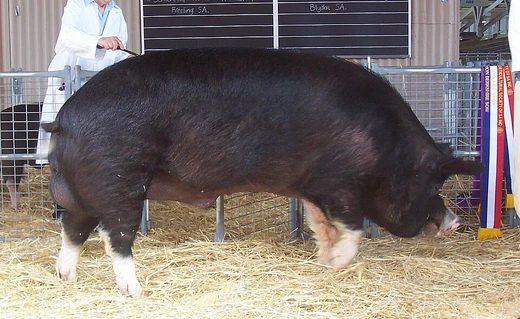
British Saddleback
A modern British pig breed created from Essex and Wessex Saddlebacks.
The British Saddleback is a modern pig breed from Britain, created in 1967 when the last remaining groups of two older saddleback types—the Essex and the Wessex Saddleback—were combined into a single breed. It is currently considered endangered, with the Rare Breeds Survival Trust listing it as “at risk,” which is the second most serious category on their watchlist.
This breed came about after the Howitt report of 1955 discouraged breed diversity in the British pig industry, pushing instead for just three main breeds: the Welsh, British Landrace, and Large White. Both the Essex and Wessex breeds had been in steep decline. During World War II, these two breeds made up about 47% of all pedigree sow registrations, and in 1949 there were 2,435 licensed boars from them—nearly a quarter of the total. By 1954, however, their share had dropped to just 22% of sow registrations and under 10% of registered boars. The advice at that time was to cross saddleback sows with a white boar to create a pig suitable for both pork and bacon.
In 2007, the Food and Agriculture Organization of the United Nations listed the British Saddleback as “endangered-maintained.” The Rare Breeds Survival Trust later classified it as a “minority breed” in 2016 rather than a rare breed. Reported numbers fell from 882 in 2012 to just 378 by 2019. By 2022, DAD-IS listed it as at risk/endangered, and the Rare Breeds Survival Trust’s 2022–2023 watchlist again gave it an “at risk” status, the second-highest level of concern. Saddlebacks have been exported to several countries, including Bhutan, Brazil, Indonesia, the Leeward Islands, Nepal, Nigeria, Russia, the Seychelles, and the Solomon Islands.
Physically, the British Saddleback is a large, deep-bodied pig. It is black with a white band, saddle, or sheet across the withers, shoulders, and front legs; some white is also allowed on the nose, tail, and hind feet. It has lop ears and a fine, straight, silky coat.
As a breed, it is hardy and good at foraging, making it well suited to extensive management. It serves a dual purpose, producing both pork and bacon. It is also one of the most prolific British pig breeds, with average litters of about ten piglets, and sows are known for strong maternal instincts.
- breed
- British Saddleback
- origin
- Britain
- created
- 1967
- conservation_status
- At risk (second-highest level of concern)
- population_2019
- 378
- known_for
- Dual-purpose pig for pork and bacon; hardy forager; prolific with average litter size of 10
Lore & Background
The British Saddleback was created in 1967 by merging the remaining populations of the Essex and Wessex Saddleback breeds into a single herd-book. Both breeds had declined following the 1955 Howitt report, which found breed diversity a handicap and concentrated production on the Welsh, British Landrace, and Large White breeds. During the Second World War, Essex and Wessex breeds accounted for 47% of pedigree sow registrations, but by 1954 they made up only 22% of sow registrations and fewer than 10% of registered boars.
Reader's Guide
The British Saddleback represents a significant effort to preserve genetic diversity in British pig farming after the post-war consolidation of the industry. Its creation in 1967 from the Essex and Wessex Saddleback breeds saved the remaining bloodlines from extinction. The breed is large, black with a white saddle, and lop-eared, with a fine, straight, silky coat. It is hardy and forages well, making it suitable for extensive management, and is among the most prolific of British pig breeds, with an average litter size of about 10. Sows have good maternal qualities. Despite its utility, the breed has faced ongoing decline: the population fell from 882 in 2012 to 378 in 2019. It is listed as at risk by the Rare Breeds Survival Trust and as at risk/endangered in DAD-IS. Saddlebacks have been exported to countries including Bhutan, Brazil, Indonesia, Nepal, Nigeria, and the Russian Federation, indicating international interest in the breed.
Did You Know?
- The British Saddleback was created in 1967 by merging the Essex and Wessex Saddleback breeds.
- During the Second World War, 47% of pedigree sow registrations were from the Essex and Wessex breeds.
- The breed's population fell from 882 in 2012 to 378 in 2019.
- Saddlebacks have been exported to Bhutan, Brazil, Indonesia, Nepal, Nigeria, and the Russian Federation.
Frequently Asked Questions
What is the British Saddleback?
The British Saddleback is a modern dual-purpose pig breed from Britain, raised for both pork and bacon production. It is known for being a hardy forager and for producing prolific litters averaging around ten piglets.
How was the British Saddleback breed created?
In 1967, the last surviving groups of the Essex and Wessex Saddleback types were merged into a single unified breed. This consolidation came after the 1955 Howitt report pushed the British pig industry to focus on just three commercial breeds, effectively threatening the older saddleback lines with extinction.
What is the British Saddleback's status on the RBST watchlist?
The Rare Breeds Survival Trust places the British Saddleback in the 'at risk' category, the second most serious level on their watchlist. With only 378 registered animals recorded in 2019, the breed remains very close to disappearing entirely.
What makes the British Saddleback useful to farmers?
It serves as a versatile dual-purpose animal, yielding quality pork and bacon while also foraging well on pasture without intensive feeding. Its reliable breeding, with litters of roughly ten piglets, makes it a productive fit for smallholdings and conservation farms.
Why is the British Saddleback important to conservation efforts?
The breed carries the combined genetic heritage of two older saddleback types that were nearly wiped out by post-war industry consolidation favoring a handful of commercial breeds. Saving it preserves a unique thread of British pig genetics that would otherwise be lost forever.
More in part-1
Spotted an error? Know more?
This is a living reference — every entry is fact-audited, and reader corrections feed straight into our audit queue. Suggest an edit · See this site's audit record