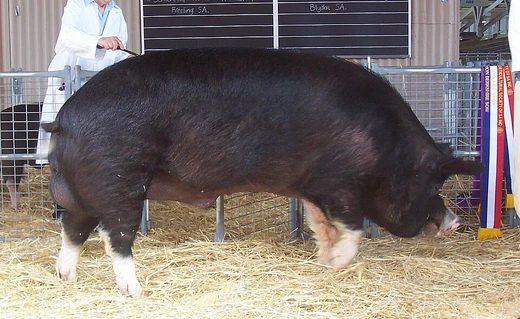
British Lop
A rare white lop-eared pig from the West Country.
The British Lop is a traditional pig breed originating in the West Country of southwestern England. It is a large pig with white skin and lop ears that droop forward over its face. Earlier names included the Cornish White, Devon Lop, Long White Lop-eared, and White Lop, with the current name adopted during the 1960s.
The earliest records of this breed come from the border area between Cornwall and Devon, especially near Tavistock. It may be linked to similar pigs from northwestern Europe, such as the Welsh breed (with which it shared a combined herd-book for a time in the 1920s), the Scandinavian Landrace, and possibly the Normande pigs of France. A dedicated herd-book first appeared in 1921, following popular classes at the Devon County Show that year. By the late 1930s, many purebred Lops were registered, mainly in the southwest. After World War II, the British government encouraged standardisation on just three breeds—Large White, Welsh, and Landrace—causing numbers of other breeds to drop. During the 1960s and 1970s, only about eleven breeders kept the British Lop going.
The British Lop is large, white-skinned, and heavy-set, with a much deeper body than the similar Welsh or Landrace pigs. It was developed to thrive mainly on grazing and is still often kept outdoors. Unlike most surviving British pig breeds, it appears to have had little or no influence from the Asian pigs imported for breeding in the nineteenth century. It is good at putting on lean weight and is especially known for a gentle temperament.
In the twenty-first century, breed numbers have risen compared to the 1960s and 1970s. In 2022–2023, the British Lop was one of seven pig breeds listed as 'priority'—the highest risk level—on the Rare Breeds Survival Trust watchlist. Clarissa Dickson Wright once noted that "The British Lop is rarer than the Giant Panda."
- origin
- West Country, south-western England, particularly the border of Cornwall and Devon
- also known as
- Cornish White, Devon Lop, Long White Lop-eared, White Lop
- modern name adopted
- 1960s
- first herd-book published
- 1921
- conservation status
- Priority (highest risk) on the Rare Breeds Survival Trust watchlist (2022–2023)
- key traits
- Large, white-skinned, lop ears, heavy-set, deep body, gentle temperament
Lore & Background
The earliest records of the breed are from the border of Cornwall and Devon, particularly the area around Tavistock. It is possibly related to similar breeds found around the north-western fringes of Europe, namely the Welsh, with which it was for a period in the 1920s in a combined herd-book, and the Landrace pig breeds of Scandinavia. It may also be related to the Normande pigs of France. The first herd-book was published in 1921, subsequent to the popularity of classes at the Devon County Show in that year. By the late 1930s large numbers of purebred Lops were registered, predominantly in the south-west.
Reader's Guide
The British Lop is significant as a traditional British pig breed that survived a period of severe decline after the Second World War, when the British Government recommended standardising production on three breeds (Large White, Welsh and Landrace). During the 1960s and 70s only around eleven breeders kept the British Lop going. Its conservation status remains critical: in 2022–2023 it was one of seven pig breeds listed as 'priority' on the Rare Breeds Survival Trust watchlist. The breed is notable for having had little or no input from imported Asian pigs used in much nineteenth-century breeding, unlike most surviving British pig breeds. It was developed to support itself primarily on grazing and is still often raised outdoors. The British Lop has a good ability to put on lean weight and is particularly noted for a gentle temperament. Clarissa Dickson Wright commented that 'The British Lop is rarer than the Giant Panda.'
Did You Know?
- The British Lop was formerly known as the Cornish White or Devon Lop.
- The first herd-book was published in 1921 after classes at the Devon County Show.
- During the 1960s and 70s only around eleven breeders kept the British Lop going.
- Clarissa Dickson Wright commented that 'The British Lop is rarer than the Giant Panda.'
Frequently Asked Questions
What is the British Lop?
It is a traditional pig breed from southwestern England, instantly recognizable by its white coat and long ears that drape forward over the face. It is one of the oldest documented pig types in the region.
Where did the British Lop originate?
The breed traces its roots to the borderlands between Cornwall and Devon, with the earliest records clustered around Tavistock. It may also share ancestry with similar white pigs found elsewhere in northwestern Europe.
What does a British Lop look like?
It is a large, heavy-set pig with a deep body, white skin, and notably long lop ears that flop over its face. Despite its considerable size, it is well known for a calm and gentle temperament.
Why is the British Lop on the RBST watchlist?
It holds the highest-risk 'Priority' conservation rating for 2022–2023, meaning its surviving population is critically small. Active breeding and conservation work are essential to keep the breed from vanishing entirely.
What was the British Lop called before its current name?
Before the 1960s, the breed went by several regional names, including Cornish White, Devon Lop, Long White Lop-eared, and White Lop. The unified name 'British Lop' was settled during that decade to standardize identification across the breed.
More in part-1
Spotted an error? Know more?
This is a living reference — every entry is fact-audited, and reader corrections feed straight into our audit queue. Suggest an edit · See this site's audit record