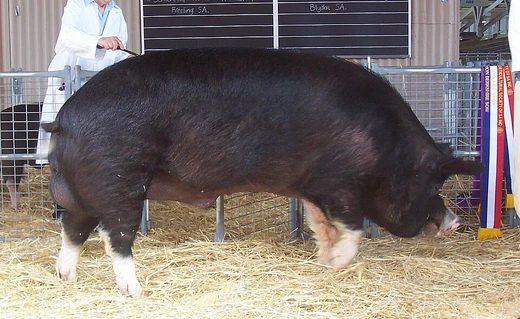
Gloucestershire Old Spots
Oldest pedigree spotted pig breed, known for hardiness and maternal skill.
The Gloucestershire Old Spots is an English breed of pig predominantly white with black spots, named after the county of Gloucestershire. It is known for its docility, intelligence, prolificity, and hardiness, and is recognized as the oldest pedigree spotted breed in the world.
- Origin
- England, county of Gloucestershire
- Breed type
- Pig
- Weight (boar)
- 600 lb (272 kg)
- Weight (sow)
- 500 lb (227 kg)
- Coat color
- White with clearly defined black spots
- Conservation status
- Critical (US) / At Risk (UK)
- Known for
- Docility, maternal skills, hardiness, oldest spotted pedigree breed
Lore & Background
The Gloucestershire Old Spots Breed Society was formed in 1913, and the breed was called 'Old' Spots because it had been known for as long as anyone could remember. The first pedigree records of pigs began in 1885, much later than for other livestock, as the pig was considered a peasant's animal. No other pedigree spotted breed was recorded before 1913, making the GOS the oldest such breed in the world. The breed is also known as the 'Orchard Pig' and 'The Cottager's Pig', reflecting its humble origins, yet both The Prince of Wales and The Princess Royal keep GOS pigs on their Gloucestershire estates.
Reader's Guide
The Gloucestershire Old Spots pig is significant for its historical role as a hardy, self-sufficient breed suited to pasture-based farming. Its maternal skills enable it to raise large litters on pasture, and its calm temperament makes it desirable for small farmers and homesteaders. The breed contributed genetically to the American Spot and Chester White, and is similar to the extinct Cumberland pig, which it is being used to recreate. With the rise of intensive farming, many old breeds declined, but consumer demand for quality meat and outdoor-reared pigs has revived interest in the Old Spots. It is currently listed as 'Critical' by The Livestock Conservancy in the US and 'At Risk' by the Rare Breeds Survival Trust in the UK. In 2010, its meat gained European Commission Traditional Speciality Guaranteed status, certifying its consistent production methods for at least 30 years.
Did You Know?
- The Gloucestershire Old Spots is the oldest pedigree spotted breed in the world, with no other spotted breed recorded before 1913.
- The breed is also called the 'Orchard Pig' and 'The Cottager's Pig' due to its historical role as a scavenger and peasant's animal.
- Both The Prince of Wales and The Princess Royal keep Gloucestershire Old Spots pigs on their estates in Gloucestershire.
- The breed's meat received Traditional Speciality Guaranteed status from the European Commission on 29 July 2010.
More in part-1
Spotted an error? Know more?
This is a living reference — every entry is fact-audited, and reader corrections feed straight into our audit queue. Suggest an edit · See this site's audit record